Tuesday, October 8, 2013

PHILLY FALL & THE FERNHILL FRUIT


Now, where was I?

That’s right, it’s autumn here in Philadelphia.


Now, how does that quote go again, the one about autumn?  Think, Jon Spruce.  Who was it again?

That’s right, it was Albert Camus, the French philosopher.  Now, he was an absurdist but don’t worry, Donny, there’s nothing to be afraid of.

Every now and then, even an absurdist is worth listening to.


Autumn is a second spring when every leaf’s a flower.


Zut alors!  He was right.

Season of the tawny dawn, season of the rustic twilight, the brisk walk…


…the green world’s final curtain call.

Now, Jon Spruce, pay attention.

This is how it turns.  This is how it falls.

Tuesday, August 27, 2013

BEECH READINGS, PART TWO


I got a bad feeling about this.


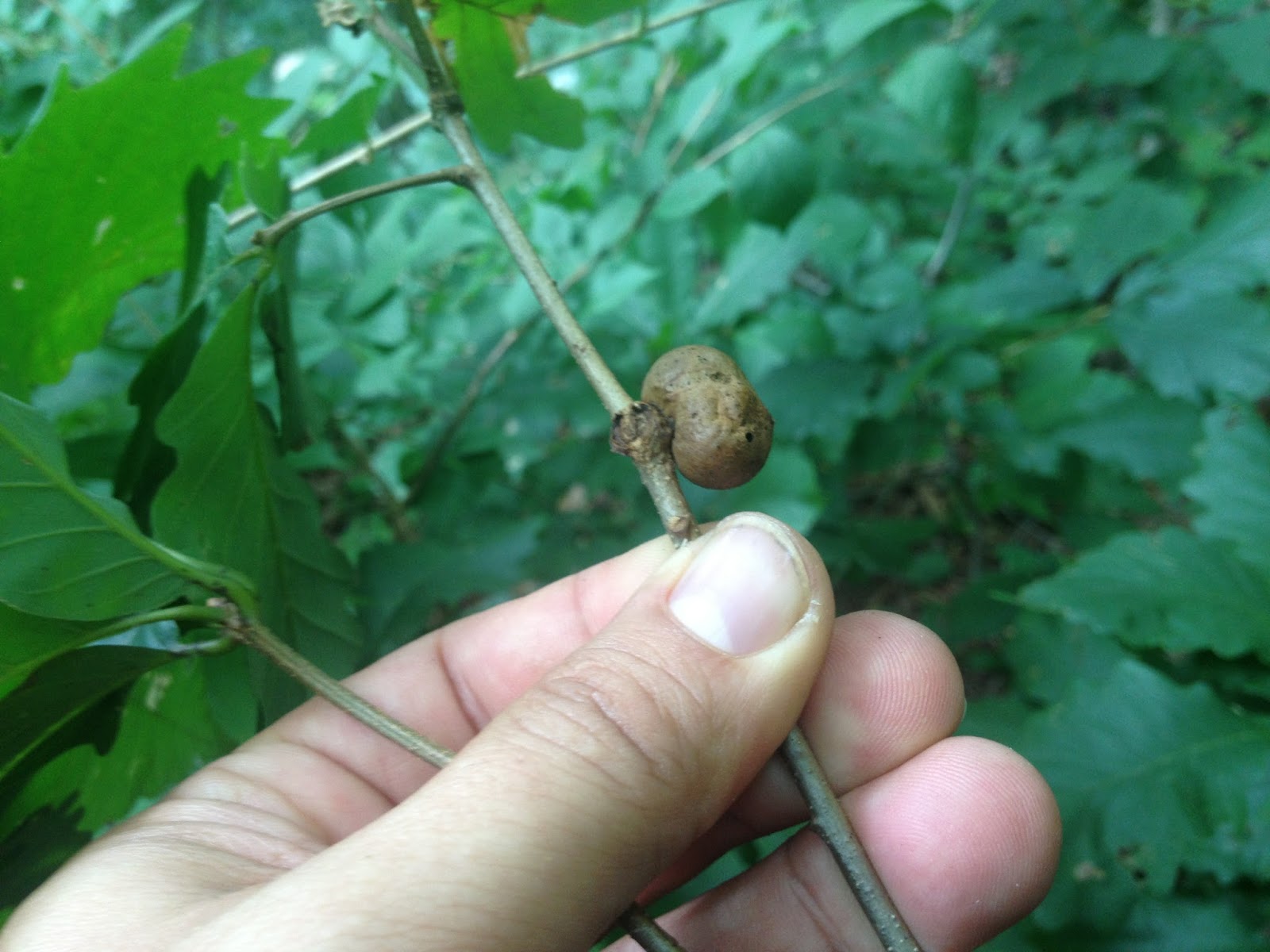
I was climbing down the rocky slopes towards the Catfish Creek when I caught sight of this brown pod…


…attached to a branch of that scrub chestnut oak.

It just plucked off, right into my hand, a snap of the fingers.

It had almost no weight to it.  I carried it in a loose fist towards the beach…


…and laid it out on the big rock for a little alien autopsy.

I’m not at all qualified to do this.

My first instinct?  This must be some sort of fungus or mold, not the most intelligent of life-forms but one that fills a very important niche here in the forest biome.

Fungus is actually how the trees communicate with each other.

It’s true.

Alerted to pests or diseases, even bad weather or fire, the trees will pump out chemicals into the ground, signals to other trees.

The fungus is able to pick up these messages and send them through their wires to the next tree…


…an underground and undercover communication grid that connects root to root, the fungus playing the role of the long-distance operator.

It’s happening right below my boots and yet I can’t see it, can’t hear it, can’t feel it no matter how hard I try.


I have to admit I was a little jealous.

So the trees can talk to each other?  They just won’t talk to me.

Is it too much to ask for a simple hello?  After all we’ve been through together?

The answer, for the time being, is no.

But maybe inside this pod…


…I can catch some sort of signal, some sort of contact.  Maybe there is some message, once intercepted, that can crack the code.

The Rosetta Stone of tree-talk.  It could be right there under my knife, a discovery that would secure Jon Spruce’s place in the pantheon of champion tree-hunters.

First man to talk tree.

But, like I said, I got a bad feeling about this.


I hate it when I’m right.

Saturday, August 10, 2013

BEECH READINGS, PART ONE


Awakening this morning from uneasy dreams, I realized that I had the whole day to myself, no promises, no obligations, no errands, no dues.

Ah, summer.

So, like most people with a summer day to burn, I went down to the beach…


…to the banks of the Schuylkill River to catch some rays, a new paperback in hand.

It was a typical day under the Ripe Berry Moon, although a little bit cooler than usual for this time of year, not something I’m complaining about.


The sunshine glared off the muddy shore, lighting up every little pebble, every half-buried rock, every stray two-by-four and soda can washed ashore.  The wind was blowing both jasmine and diesel, pulling the waves towards the beach on a string.

And the best part?  I was entirely alone. 

Unlike most beaches, this was a secluded place away from the noisy masses, a hidden cove.

Next to me, there was a large patch of high plants, no idea what they’re called.


I usually don’t like sitting so close to strangers but, to be honest, they didn’t look very friendly or inviting…


…those puckered mouthpieces inching their way towards me and my summer repose.

Unable to resist, I did grab one of those gaping maws and pulled back the thick lip of leaves…


…only to reveal the cranks and gears of their peculiar engineering.

Such odd parts…but, then again, I’m sure if something ripped open my own fleshy envelope, it would also reveal some odd parts, a strange system of beating sprockets and mammalian machines.

Those tangled stalks dominated half the beach here and seemed to catch the entire spectrum of Philly’s flotsam and jetsam: beer cans, plastic bags, trash and refuse and litter, two car batteries and one dead, bloated fish.


Warning: August is not for the squeamish.

This is Nature’s most efficient season, when it’s at its reddest in tooth and claw, the hunter and the hunted dancing around the arena of Survival, the predator and the prey in high pursuit, life and death around every bend in the trail.  

The most dangerous of hunger games.

The Wheel right now is cranking away at a breakneck speed, around and around the lifeless Void that lies at the very center of its heartless hub.

Ah, summer.

Do or die. 

It’s a cold thought for a summer day and I shouldn’t let one patch of unfriendly plants, and one dead fish, ruin my summer day at the beach, or ruin the experience of sinking into the curious novel I found stacked away at a local used book store.


It was love at first sight.

TREE HUGGING

On an alien world, a bizarre and intelligent plant offers more than just companionship…Strange Relations.

Thursday, July 18, 2013

THE STRONG SUN MOON


It’s a jungle out there.


The city is stewing.  The streets are roasting.  The roof is on fire. 

Baby, it’s hot outside, during these final days of the Strong Sun Moon.

Citybillies, take cover wherever you can.


This is not my weather of choice, this is not my season.  After all, I am an Elk of the Thunderbird Clan, born under the Long Snow Moon of mid-Decembertime, but I refuse to stay inside.

Can’t let this brutal heat wave keep me off these scorching streets and away from those steamy woods, still lots to catch and hunt.

Nice try, Coyote.

Windows down and sunglasses on, I’m going out, through the swelter and into the sizzle, head-first into the fever.

Gotta love the burn.

This might make me sound like a glutton for punishment but I’m going straight for it.  I’m going hunting for the highest, hottest totem of this season.

Set the controls for the heart of the sun.


Saturday, July 6, 2013

SWEET LAND OF LIBERTY, OF TREE I SING


It’s Independence Day Weekend here in Philadelphia.  What a fine time to be in the city.


Block parties and live music, barbecues and picnics, burgers and ice cream, sparklers and fireworks, road-blocks and detours, this city truly lives up to the standards and expectations of Founding Farmer John Adams, who once wrote that Independence Day ought to be solemnized with pomp and parade…


…with shows, games, sports, guns, bells, bonfires and illuminations, from one end of this continent to the other, from this time forward forever more.

Well, actually, he always thought it should be celebrated on the Second of July.

Sorry, old man.

In the Fourth we trust…a celebration of the tried and true totems of American history: the bald eagle and the buffalo, Yankee Doodle and Uncle Sam and Lady Liberty…


…the light bulb and the television and the arcade game, the steamship and the automobile and the space shuttle, the pioneer and the cowboy and the rock star…


…and that Old Glory herself…


…that grand old flag we call the Stars and Stripes.

In the spirit of Independence Day, I made a quick pit-stop to pay my respects to our most famous seamstress, Betsy Ross.


She’s buried, right there in Olde City, at 2nd and Old Sassafras Streets, underneath that monumental American elm…


…rocketing over the colonial courtyard, bursting with heavy branches high up in the muggy Coyote sky.

Or, at least, we’re told that she’s buried here.

It turns out that Betsy Ross’s funeral was held on 5th Street.  Twenty years later, her body was exhumed and moved to the now abandoned Mount Moriah Cemetery near Cobbs Creek in West Philly…


…and then, just in time for the Bicentennial of 1976, her body was moved again to this half-museum-half-gift-shop restoration, to be closer to the parade of her colonial brothers and sisters.


Or was she?

Rumor has it that, back in 1975, her gravediggers found no bodily remains under her tombstone there in Mount Moriah. 

Only a few bones, found elsewhere in the family plot, were hastily authenticated as Betsy Ross’s and moved to this courtyard…


...just in time for the opening of the Betsy Ross Bridge in 1976.

It doesn’t matter.

Fiddle-de-dee.

Like we say here in America, when the legend becomes fact, print the legend.

And so the legend stands.

She’s buried here, First Seamstress of the United States, the beautiful and noble widow who made, with her own blistered hands, the very first version of the American Flag.


Or did she?

Monday, June 24, 2013

TREES ON THE ROAD


There I was, enjoying the daylights out of these long, long days of June, reading the local paper in the backyard of my urban cabin, when a headline caught my eye:


It’s been a while but here we have our first sighting of the Wildman for 2013, timed perfectly to the first super-moon of summer.

Ain’t that just like Coyote?

The Wildman has been lurking on the outskirts of our civilization since the very beginning of tamed society, usually appearing as figments and fancies of the imagination: centaurs, minotaurs, mermaids and werewolves, shamans turning into eagles, hunters becoming the hunted, husbands waking up as buffalo, bear or antelope…


…doomed souls who answer too frequently the call of the wild: Merlin and the Green Knight, Tarzan and Mogwai, Santa Claus, the shipwrecked kids from The Lord of the Flies and, my favorite, the half-man half-plant superhero called Swamp Thing.


But it’s wrong to pigeonhole the Wildman as pure fiction.  Sometimes, he is as real as you and me, right there in black and white.


That’s Joseph Knowles, one of the most famous Wildmen in American history.  That’s a publicity shot, when he made his triumphant return to Mother, and civilization, after spending two months, living like a primitive, in the Maine Woods near Bear Lake.

He turned wild in August 1913. 


Surrounded by the New England mass media of the day, he stripped down to his jockstrap, took a few drags of a cigarette, said a hearty “See you later, boys!” and jumped, head-first and barefoot, into the wilds.

According to his memoirs, he constructed a little lean-to shelter in the pine woods, learned how to forage and hunt and fish, how to build fire, carve weapons and make clothing.

Before leaving the rat-race, he was an illustrator and cartoonist, so he also spent the free days observing the College of Nature, as he liked to call it, drawing the placid, pastoral scenes on the backsides of birch bark.


It was a story that captivated the nation back in 1913.

Have you ever noticed that stories of the Wildman, no matter what’s happening in the bigger world, always make it through the scuttlebutt, always seem to get some sort of headline?

According to the press, Wildman has legs.


Now, let’s see what he’s doing over there in California.

A 56-year old man with long wild hair and beard tossed a spear at a passing vehicle in Sacramento, California.

A caller told police that a man standing on the road had hurled the spear at the vehicle.  The spear then became stuck in the vehicle’s front fender.

It was not clear why the wild man threw the spear.

Ha!  Not clear why?  Open your eyes, Reuters!  The answer is very clear.

It’s called traffic, man.

And sometimes it’s a doozy. 


Cars and more cars everywhere you turn, major roadways closed, construction around every corner, watching out for bicyclists and pedestrians and jaywalkers, bumper to bumper all along the highways, nothing but volume up and down the Roosevelt Boulevard all the way from Academy to the Blue Route…


…it ain’t easy being cooped up in a sweltering car, inching forward to the next detour or the next red light.

If you got any bit of Wildman in you, it’s horrible…just a bunch of expensive cages sitting still on the hot asphalt, pumping exhaust and burning fuel, going nowhere.

And as far as trees go, there’s not much to see along most highways…


…frigging ailanthus.

It’s enough to make anyone batty.

That’s why I keep a few road-side trees on my mental map, just a few notable and rare trees always on my radar, sturdy and dependable landmarks right along the roads and highways that make the slog through traffic just a little more bearable.

Wednesday, June 5, 2013

COOKERY WITH JON SPRUCE


In 1747, a young British wife of an Irish soldier wrote and published what would become a most popular book.

Her name was Hannah Glasse and the book was The Art of Cookery Made Plain and Easy.  It was reprinted twenty times by the end of the 1700s and could be found in just about every kitchen in the English countryside and the American colonies.

It is considered one of the first collections of rural recipes, designed for the home and the hearth instead of the court and the castle, and written in plain English to help and instruct wives and domestic servants instead of chefs, hunters, butchers and gourmets.

It was the first cookery book to take into account a house’s purse and economy, favoring the local herbs, fruits and wild game that could be found and hunted, for free or for cheap, in the typical rural village, out in the street markets or along the country roads.

This, in itself, was revolutionary.  The subtitle of the book says it best: far exceeds any Thing of its Kind yet publifhed.


At the end of her introduction, Hannah Glasse states her simple mission: only hope my Book will answer the ends I intend it for; which is to improve the servants, and save the ladies a great deal of trouble.

Flipping through the table of contents, there are recipes for every sort of occasion and audience. Chapter Four is entitled: To make a number of pretty little dishes fit for a supper, side dish, and little corner dishes for a great table.  Chapter Ten contains recipes under the heading, Directions for the Sick, and Chapter Eleven is written For Captains of Ships.

There’s even a recipe for moonshine, plus directions on how to make homemade wines using raspberries, quince, cherries, elderberries and dandelion.

She cooked with a whole different menagerie of animals.  Sure, you got the usual proteins of beef, pork, poultry, mutton and eggs, plus salmon and carp and cod, anchovies and mackerel.

But then there are recipes for tame ducks, teal, wigeons, woodcocks, snipes, partridges, pigeons, lark and eel.


One of her most famous recipes is for traditional jugged hare.  We would call it rabbit stew except, when making jugged hare, you stuff the hare in a jug and place the jug in the pot of simmering broth.

That’s a technique that hasn’t survived into the twenty-first century but I’m not complaining.  In the end, Hannah’s directions are to just pick apart the meat from the bones of the hare and add it to the flavorful broth, serve hot.

Skipping that step seems okay.  Saving trouble was Hannah’s goal, after all, and in today’s modern kitchen, actually jugging a hare seems like a whole mess of trouble.

But what about the first step of her recipe?

Go catch ye a hare.

We've made it pretty easy to skip that step too.

Well, not me.

Not this time.  Not now, especially not now. 

Citybillies, these are the days and nights of the Strawberry Moon and there is plenty of food out there for the taking, just ripening on the vine, ready to be plucked and picked from the mean streets of the city grid and into the warm kitchen of the urban cabin.

So, in the great tradition of Hannah Glasse, I humbly present Cookery with Jon Spruce


…wherein I will forage and prepare one of spring’s best recipes, featuring two of my favorite Strawberry Moon ingredients.


“OUR DIET MUST ANSWER TO THE SEASON…”

First step in this recipe?

Fetch ye some honeysuckle.