Showing posts with label west philly. Show all posts

Saturday, July 6, 2013

SWEET LAND OF LIBERTY, OF TREE I SING


It’s Independence Day Weekend here in Philadelphia.  What a fine time to be in the city.


Block parties and live music, barbecues and picnics, burgers and ice cream, sparklers and fireworks, road-blocks and detours, this city truly lives up to the standards and expectations of Founding Farmer John Adams, who once wrote that Independence Day ought to be solemnized with pomp and parade…


…with shows, games, sports, guns, bells, bonfires and illuminations, from one end of this continent to the other, from this time forward forever more.

Well, actually, he always thought it should be celebrated on the Second of July.

Sorry, old man.

In the Fourth we trust…a celebration of the tried and true totems of American history: the bald eagle and the buffalo, Yankee Doodle and Uncle Sam and Lady Liberty…


…the light bulb and the television and the arcade game, the steamship and the automobile and the space shuttle, the pioneer and the cowboy and the rock star…


…and that Old Glory herself…


…that grand old flag we call the Stars and Stripes.

In the spirit of Independence Day, I made a quick pit-stop to pay my respects to our most famous seamstress, Betsy Ross.


She’s buried, right there in Olde City, at 2nd and Old Sassafras Streets, underneath that monumental American elm…


…rocketing over the colonial courtyard, bursting with heavy branches high up in the muggy Coyote sky.

Or, at least, we’re told that she’s buried here.

It turns out that Betsy Ross’s funeral was held on 5th Street.  Twenty years later, her body was exhumed and moved to the now abandoned Mount Moriah Cemetery near Cobbs Creek in West Philly…


…and then, just in time for the Bicentennial of 1976, her body was moved again to this half-museum-half-gift-shop restoration, to be closer to the parade of her colonial brothers and sisters.


Or was she?

Rumor has it that, back in 1975, her gravediggers found no bodily remains under her tombstone there in Mount Moriah. 

Only a few bones, found elsewhere in the family plot, were hastily authenticated as Betsy Ross’s and moved to this courtyard…


...just in time for the opening of the Betsy Ross Bridge in 1976.

It doesn’t matter.

Fiddle-de-dee.

Like we say here in America, when the legend becomes fact, print the legend.

And so the legend stands.

She’s buried here, First Seamstress of the United States, the beautiful and noble widow who made, with her own blistered hands, the very first version of the American Flag.


Or did she?

Wednesday, June 5, 2013

COOKERY WITH JON SPRUCE


In 1747, a young British wife of an Irish soldier wrote and published what would become a most popular book.

Her name was Hannah Glasse and the book was The Art of Cookery Made Plain and Easy.  It was reprinted twenty times by the end of the 1700s and could be found in just about every kitchen in the English countryside and the American colonies.

It is considered one of the first collections of rural recipes, designed for the home and the hearth instead of the court and the castle, and written in plain English to help and instruct wives and domestic servants instead of chefs, hunters, butchers and gourmets.

It was the first cookery book to take into account a house’s purse and economy, favoring the local herbs, fruits and wild game that could be found and hunted, for free or for cheap, in the typical rural village, out in the street markets or along the country roads.

This, in itself, was revolutionary.  The subtitle of the book says it best: far exceeds any Thing of its Kind yet publifhed.


At the end of her introduction, Hannah Glasse states her simple mission: only hope my Book will answer the ends I intend it for; which is to improve the servants, and save the ladies a great deal of trouble.

Flipping through the table of contents, there are recipes for every sort of occasion and audience. Chapter Four is entitled: To make a number of pretty little dishes fit for a supper, side dish, and little corner dishes for a great table.  Chapter Ten contains recipes under the heading, Directions for the Sick, and Chapter Eleven is written For Captains of Ships.

There’s even a recipe for moonshine, plus directions on how to make homemade wines using raspberries, quince, cherries, elderberries and dandelion.

She cooked with a whole different menagerie of animals.  Sure, you got the usual proteins of beef, pork, poultry, mutton and eggs, plus salmon and carp and cod, anchovies and mackerel.

But then there are recipes for tame ducks, teal, wigeons, woodcocks, snipes, partridges, pigeons, lark and eel.


One of her most famous recipes is for traditional jugged hare.  We would call it rabbit stew except, when making jugged hare, you stuff the hare in a jug and place the jug in the pot of simmering broth.

That’s a technique that hasn’t survived into the twenty-first century but I’m not complaining.  In the end, Hannah’s directions are to just pick apart the meat from the bones of the hare and add it to the flavorful broth, serve hot.

Skipping that step seems okay.  Saving trouble was Hannah’s goal, after all, and in today’s modern kitchen, actually jugging a hare seems like a whole mess of trouble.

But what about the first step of her recipe?

Go catch ye a hare.

We've made it pretty easy to skip that step too.

Well, not me.

Not this time.  Not now, especially not now. 

Citybillies, these are the days and nights of the Strawberry Moon and there is plenty of food out there for the taking, just ripening on the vine, ready to be plucked and picked from the mean streets of the city grid and into the warm kitchen of the urban cabin.

So, in the great tradition of Hannah Glasse, I humbly present Cookery with Jon Spruce…


…wherein I will forage and prepare one of spring’s best recipes, featuring two of my favorite Strawberry Moon ingredients.


“OUR DIET MUST ANSWER TO THE SEASON…”

First step in this recipe?

Fetch ye some honeysuckle.

Wednesday, April 3, 2013

PHILLY MOUNTAIN SPRING LOOKOUT JOURNAL


I woke up this morning after another one of those fitful nights.

Tossing and turning, I just could not settle into a steady state of sleep, I don’t know why.

Going to sleep was never that easy but getting up never used to be this hard.

Walking outside, I stopped dead in my tracks.

It’s freezing and I’m not surprised but I’m tired of it. 

Where is spring?  Where’s the show?

Where have all the flowers gone?

This isn’t the spring that’s advertised, not the spring I was expecting.  This is not the spring that’s promised.

I don’t know about you but I’m not taking it lying down anymore.  I’m tired of waiting around for spring, waiting around for flowers.  They’re out there.  I’m sure of it.

Forget the errands and ditch the plans…I’m going hunting for spring flowers.

I went back inside the cabin and laced up my boots.  This winter might be hanging on longer than expected but it’s got to be spring somewhere in this fair and filthy city.  I grabbed my field guides and I grabbed my hat.  Then, I punched some buttons on my iPhone and I downloaded some apps.

I got a Thermometer App and I got an Altimeter App.

That’s right.  I’m going to start this hunt at the highest heights.  I’m climbing straight to the top of Philly Mountain and I’m not going to stop until I get to the lowest low.

I’m going to scour this city top to bottom.

Somewhere along the line, I’m going to find some spring flowers.

One quick look around my apartment in case I was forgetting anything.

That’s right.  I’ll need my mountain lookout journal and a good pen.  Now just need to fill up the canteen with some cider and I’m set…on my way to the top of the city…up, up and away…


Sunday, March 17, 2013

NATURE'S FIRST GREEN


For the last week or so, I’ve been keeping my senses alert for the earliest signs of spring.

In a lot of ways, spring is our most flamboyant season but I just know, somewhere out there, it’s making a subtle entrance.

Despite the cold chill and the last flurries, I know spring is happening, can feel it in my bones.

The race is on.  Spring.  Nature’s first green.

But I didn’t want to catch the kind of spring that makes the news. 

That kind of spring is easy to see, hard to overlook.  It’s a princess.  I wanted to find the kind of spring that doesn’t need to announce itself, the kind of spring that opens the windows for the rest of the season, the trigger that draws back the curtains and calls the rest of the kingdom to rise.

That was my hunt: spring’s modesty.

I wanted to find the meek spring before its gets too gaudy and too flashy.

It’ll take keen eyes, a quiet mind and small hands to notice its arrival but isn’t that always the case when it comes to noticing humility?

There are, of course, the big signs of spring, signs so big that they are beyond my four dimensions, signs that go unnoticed by my own feeble five senses.

Like the length of days.  Beginning on March 17th, the day is now equal parts sunlight and moonlight.  Check the almanac.  Sunrise at 6:52am, sunset at 6:53pm.

The twelve-hour day is back.

We’re seven days ahead of Daylight Savings Time, six days past the new moon, two days beyond the Ides of March and three days away from the vernal equinox.

According to the Medicine Wheel, we’re in the transitional phases between the Big Wind Moon and the Budding Trees Moon.

But look at that calendar.

This March spans five weeks, enough room to squeeze in just a few extra phases.  This is sometimes called the Full Worm Moon, a time when the ground softens and the worms begin turning the soil and crawling back into the sunlight which is, itself, a trigger for the birds to return. 

Up north in New England, they call it the Full Sap Moon because it’s the harvest time for maple syrup.  Go even further north, up there where the new angle of the sun now bounces off the everlasting ice, and they call it the Moon When Eyes Are Sore From Bright Snow.

But all that is just pie-in-the-sky mumbo jumbo.  What really matters?  The world is no longer pointed north.  East has arrived, spring should be here, last moon of winter.

Thank Wabun, last moon of winter.

Now, where you at, spring?

STREETSIDE SPRING

There are five common street trees that are reliably known for early spring flowering: maple, pear, cherry, dogwood, magnolia.

Thanks to all those bright lights and all that heavy traffic, plus all that body heat, the inner city grid is warmer compared to the still wild parts of the city.

So it isn’t hard to see spring’s arrival down here on the mean streets.


Sunday, February 17, 2013

CATCHING NOW


Over one hundred and fifty years ago, in a February, Henry David Thoreau wrote in his journal: we have such a habit of looking away that we see not what is around us.

It is, naturally, a February thought.

No other month is harder to catch. 

I mean, it’s already half-way over.

I must’ve blinked.

It goes by so fast.

And, like Thoreau noted one February so long ago, it’s a month that’s too easy to miss, so easy to leap over.

And it’s not just because it’s the shortest month or, according to the history of the Gregorian calendar, one of the newest months.

It’s because nothing is really happening now and, yet, that is exactly what we nature writers are trying to find.

That is, after all, the grand subject of nature writing.  It has to be about catching the now, finding the here, living the moment.

Nature writers, tree hunters, birdwatchers, storm trackers, leaf peepers, herb seekers, stargazers, moon lookers…foragers, anglers, scouts, rangers…it’s all about resisting the urge to look away and learning the skill to see the now…turning the act of observation into an exciting adventure…the passive bystander as the most dauntless and intrepid explorer ever in the history of this exact moment.

Now.  Right now.

That’s the prey.

Those fleeting, spontaneous moments happening out of the corner of the eye.  Those rare instances that take place right here in the present time.  The epiphany.  The coincidence.  The haiku.  The now.

That’s the catch.

In my experience, it’s never something you can really go out and actively hunt.  It’s just something that happens while you’re out there looking for something else.

A certain slant of shadow.  A deer on the highway.  A color, a ripple, a snow.  Running into an old friend.  An owl passing over the moon.  Dust mites in a shaft of sunlight.  A snap decision, a rash judgment, a blind leap, a wild laugh.  The plunk of an acorn hitting the roof of a car.  A perfect strawberry.  A red hot Valentine’s Day kiss.

Hey, compared to other nature hunters, I got it pretty easy.  All things considered, tree hunters have a much better chance of catching the now than other observers.

Flowers are mostly predictable, leaves are pretty much out all year round, fruit is just hanging off the branches or rotting by the curbside, and the trees themselves?  They don’t move around that much.

My now is much easier to catch than, say, a birdsong or a tornado or a dinosaur fossil or a meteorite.

But there are certain moments that happen out there in the tree-scape that, I know, I have no chance of catching.

It’s true.  No matter what I do or where I go, no matter how long I stay on the hunt, there are a handful of tree events that I will never see with my own two eyes.

Things I’ll only read about in books.

And no other tree reminds me of this sad fact more than the Hamamelidaceae hamamelis…sometimes called the winterbloom but more commonly known as the witch hazel.

THE WITCH HAZEL

I caught up with the witch hazel last weekend at the Clark Park Farmers’ Market.


Thursday, August 9, 2012

BLUE MOON TREE HUNTS


The year 2012 will go down in history as the year of broken records.

I’m not talking about the Olympics.  I’m talking about the weather.

The long-awaited annual report from the National Oceanic Atmospheric Administration was finally released and, to no one’s great surprise, it’s official: last July was the hottest month on record for the continental United States.

The previous record holder?  July 1936, the heart of the Dust Bowl era.

For 32 states, last July now ranks as one of their top ten hottest months ever. 

Remember that warm winter?  Well, consider another record broken, a record that’s stood for the last 117 years.  It’s been the warmest 12-month period in the United States since 1895.

Records are shattering all over the country.

Oklahoma has been suffering a heat wave that has lasted over 20 days.  Iowa had ten days in July of triple-digit heat…and that’s a state where they average only one of those days per year. Denver also has an average of one day of 100-plus temperatures per year.  Last month, seven Denver days went over 100-degrees, making July 2012 their hottest month ever…and that’s after suffering through their hottest June ever, back to back record-breaking months.  Remember July 7th?  You’d remember if you lived in Indianapolis.  That turned out to be their hottest day in history.  And Wisconsin?  They normally get seventeen days of 90-degree weather for the entire year…and one day of triple-digit heat every two years.  This last July?  It was all sizzle.  Seventeen days of 90-degree heat and three days when it broke over 100-degrees.  That’s an unbelievable anomaly.  Hottest month ever.  It’s not even a competition.

And for Philadelphia?  We fall right in line.  It’s been an average of three degrees warmer for the last twelve months and, for July 2012, it was an average of four degrees hotter, breaking the record for our hottest month ever.  Our previous record holder?  July 1947.

So take your place on the pedestal, July 2012.  The gold medal goes to you…and, thank Coyote, it’s over and done with…July 2012 is officially history.

Stay strong, citybillies.  The endless summer is almost ending…and, if you know your trees and plants, you’ll be able to see the signs of cooler weather even sooner than most.

One sign of the impending fall?  The sunflowers are starting to droop down, dry up and close.


Do you need some hope from the heat?  Then just pay attention to the trees. 

Saturday, July 28, 2012

THE NOTORIOUS TREE HOUSE OF FELTONVILLE


Just the other evening, I was out tree-hunting in West Philly.  It was blazing hot, steamy and sticky, so I headed to Clark Park.  I wanted to catch some shade.  I wanted to cool off and I wanted to spend the last few hours of the day watching one of my favorite oaks in the entire city.

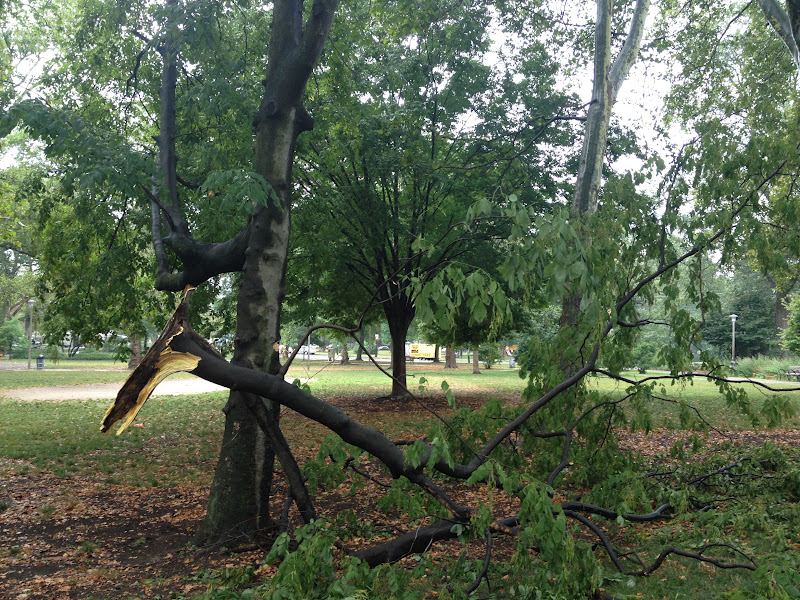
On my way through the park, I noticed that one of the recent thunderstorms had split a branch off a yellowwood tree.


Ever wonder why it’s called a yellowwood?  Well, here’s your answer:


The oak tree that I was hunting was on the other side of the park.  It’s really one of my favorite oaks in the city.  I love the way it leans over the grassy bowl.  On this particular night, the leaning oak was the setting for a Shakespeare in the Park rendition of The Merry Wives of Windsor.


William Shakespeare was, like many artists, a romantic fan of trees and flowers, plants and herbs, nature and the wilds.  Who can forget the bloody climax of Macbeth…when Thane Macduff disguises his army as trees so they can secretly advance upon the murderous Macbeth’s castle, inspiring my favorite Shakespeare quote of all time:


I, too, have seen the woods move.

So, there I was, enjoying the oak, enjoying the shade, enjoying the Shakespeare…finally cooling off, just getting used to the Old English…when my cellphone started blowing up with voicemails and text messages, all saying the same thing: Jon Spruce, turn on the local news.  There’s a tree attacking a house in the Northeast.

I need a vacation.

Thursday, July 19, 2012

THE SASQUATCH TREE


Hot enough for you?

Ain’t that just like Coyote?   Ain’t that just like the Strong Sun Moon?   

Blasting that unbearable, that stifling, that maddening heat just when you were on a roll.  Makes you want to just sit at home in air-conditioning and watch bad TV and bad baseball. Just when the days get long, just when the shore opens, just when the trees are bearing all that fruit, just when the local farmers’ markets are bedecked and bedizened with all that summer bounty.

Including the heirloom tomato, one of the greatest foods of all time… 


…and I do mean all time.  Although this is relatively a new food on the farm stand scene, it’s actually been around for a long, long time.   

This is, by anybody’s standard, an old food.

According to the farmer’s almanac, the first of the tomatoes are normally ready by the first full moon of July, usually by the rising of the next moon of the cycle: the Ripe Berries Moon.  That makes sense. 

After all, the tomato is, technically, just a giant berry.

But this abnormal heat – this gut-wrenching, sweat-pumping, underwear-clumping heat -- has launched tomato season a week or so ahead of schedule.


Ain’t that just like Coyote?

I’m not complaining.  Citybillies, take Jon Spruce’s advice: get your hands on some local 2012 heirloom tomatoes.  If there’s one thing out there enjoying this heat, it’s a tomato.

I even got a recipe for you.  Fry up two slices of bread, preferably sourdough bread.  Schmear on a guilt-free layer of mayonnaise.  Add thick slices of ripe tomato.  Sprinkle on some good salt.  Eat over the sink, alone.

The heirloom tomato is, without question, the greatest comeback ever in the long, troubled history of grocery.  Back when it was first marketed to restaurants and to grocery stores, it went under the name of ugly tomato.  It was the corporate way of explaining to the paying public that these tomatoes were supposed to be wrinkled, cracked, scarred, misshapen and, even, ripe when green, orange or yellow. 

Only years later did they start selling it under the more distinguished name of heirloom.

Yes, after years and years of subjecting the public to the year-long, season-defying crops of perfect, consistent, bland, dry, tasteless tomatoes, the Big Ag marketers had to re-educate us on the old-ways lesson that, in the wild, things sometimes get a little ugly.

Does this look ugly to you?


Each tomato is like its own little starburst.  Each one is like a little sun.  The best part?  Although you can tell which tomatoes are the same kinds of tomatoes, each one has its own rays of colors, its own patterns of wrinkles, its own carousel of flavors.


The tomato as an individual.  Sorry to say, but it’s a 21st Century Concept.

Well, more accurately, it’s a 21st Century Comeback.

These tomatoes hearken back to the good old days, before that large-scaled, mass-produced onslaught of big, red, perfect tomatoes, available year-round, bombarded the produce departments of nation-wide supermarkets.  Before the invention of refrigerated tractor trailers.  I don’t even understand why anybody even serves tomatoes outside of Coyote’s moons.  I’m talking to you, all you sandwich and hoagie shop managers.

More accurately, though, these tomatoes hearken back to the ancient farmers of South America and Mexico, the first civilizations to propagate the modern tomato.  From what we are told of heirloom varieties and seeds, these are the descendants of the kinds of tomatoes that people used to enjoy hundreds of years ago, going back to 700 AD.

Their return to our world of grocery and farm stands is a gift from the Old World, a true and treasured heirloom.


There are some trees that can also be considered heirlooms. 

Even though they may now be common all over our city grid, there are some trees that had disappeared for eons but have returned to our modern world.

Heirloom trees.

These trees hearken back to the Old Days, to the wild back-wood groves of colonial country or, even further back, to the very first days of trees themselves, to the primordial soup that bedecked and bedizened the landscapes of the super-continent we call Pangaea.

People are always asking me: Jon Spruce, if you had a time machine, where would you go?

The answer is Pangaea.

Tuesday, June 26, 2012

QUICK PICKS: THREE TREES


An average weekday in June, sun setting at 9:00pm, a quiet night at home, waiting for the rice to cool off, waiting for the thunderstorm to break, waiting for Cliff Lee’s first win, just sitting around waiting for the phone to ring, ladies…and I make the heart-breaking mistake of delving into the photo archives to look at tree-pictures I never posted.

What happened?

There are just too many trees and not enough time.

Out there on the mean streets, I always end up running into trees that don’t quite fit into my planned posts. 

I mean, I’ve missed a lot of great trees. 

The yellowwood and the black locust?   


Never got around to writing about that deep-ridged bark.  Never got around to describing their brief spell of dangling flowers in mid-spring, though I have loads of pictures.

Honey-suckle and fringe trees?   

Yeah, I missed that boat too…although even their pretty pictures can’t capture the spring breezes that always belied their presence, wafts of honey out of the corner of your eye.

The horse chestnut?  Now, that’s a big regret.   


What a spectacular miss.  It’s got everything I’m looking for in a tree.  Droopy branches.  Big-fisted, tear-drop leaves.  Bright steeples of spring flowers just popping out of the green. 

What happened, Jon Spruce?  I was busy, horse chesnut.  Busy and lazy.

Well, I won’t make the same mistake this time.  Here are three quick sketches of three notable trees…trees I just can’t watch pass by.

Tuesday, June 19, 2012

CITY PICKINGS


Ah, summer.


Long days of blue skies, big clouds, green trees, colorful flowers, warm rain, tall grass, iced coffee in the morning and Corona beers at night.  You got your flies, mosquitos and bees, sure, but you also have the hummingbirds and woodpeckers -- the season of the bear, the bat and the beaver, the ant and the squirrel. 

It’s also the season of sweating on the couch.

According to the Farmer’s Almanac, the northern summer solstice begins this week, a stretch of long, long days clocking in at 14 hours and 47 minutes, gray moons in the blue evening skies.  If we were cabin-bound in northern Inuit country, then we might be able to see old Sol, for a brief moment, standing still in the sunny midnight hour.  The origin of the word solstice is a combination of sol for “sun” and sistere which means “stands still.”

According to the Medicine Wheel, Wabun the Golden Eagle is flying away from his nest-throne and Shawnodese the Coyote Trickster begins the next three-moon reign, beginning with the paradoxical Strong Sun Moon.  Although considering that the sun and the moon share the sky during this season, maybe the Wheelmakers were on to something there.

If I had any of the spirit of Wabun in me, then I wouldn’t be here right now, in an air-conditioned urban cabin on some numbered street in just another grid in just another city somewhere along this great sprawling megalopolis. 

No, I’d be high-tailing it to the Big Horn county of Wyoming, ten-thousand feet up Medicine Mountain, and I’d be watching the sun rise along its solstice while sitting Indian-style at the southern cairn of an actual medicine wheel. 


Up on Medicine Mountain, there be one of the largest surviving Medicine Wheels, seventy-five feet in diameter, over eight hundred years old, perfectly aligned with the northern summer solstice.

Now that’s the kind of entrance that the Coyote deserves.

If Wabun the Golden Eagle is all eyes and wing, then Shawnodese the Coyote Trickster is all teeth and heart and, for better or for worse, all that the teeth devour and all that the heart ignites: love, hate, fear, sympathy, envy, jealousy, delight, rage, anger, desire, regret, hunger.

And so, it is only appropriate, that the Coyote’s three moons are dominated by the family of trees called the Roses.

Tuesday, May 15, 2012

MAYPOP

Look at this.  A nondescript street in West Philly, exact location will remain a secret for reasons that will be obvious later. 


I was walking down Street X the other day, for no particular reason.  It was an overcast day and getting muggy, which meant more rain was on its way.  I wasn't even hunting for anything but, citybilly or no citybilly, you'd have to be blind not to see the maypop.


Wednesday, April 25, 2012

PATTERNS: A KEY TO NAMING THE TREES


People are always asking me: Jon Spruce, how would you define ‘nature’ using only one word?

One word?  That’s easy.  Patterns.  The one word is patterns.

If you said cycles, I wouldn’t kick you out of the cabin.  That’s an excellent word to describe nature but I can’t see nature's cycles in my lifetime and I certainly can’t see them tree-hunting on these city streets. 


When I stare into the shaman’s fire and think in terms of nature’s endless cycles, I see images of Pangaea dispersing into continents, India crashing into China, dinosaurs surviving as birds, ice ages melting into rainforests, magma rocks building sedimentary shelves, underwater volcanoes sprouting sandy islands, drought and rain burying fossils, a 2.5-inch cone that I can squeeze between my fingers growing into the California Bigtree we call Sequoia and, above it all, the milky cloud-cover spinning forever around our blue planet.  And moss.  Lots of moss.

I’ll stick with patterns.  When I’m out tree-hunting, I’m looking for patterns.  The patterns help me identify the tree.   

Maybe it’s the way the branches are growing – opposite or alternate?  Maybe it’s the pattern of leaf shapes and sizes.  It could be the bark or the fruit.  If I can recognize the pattern that the tree is growing into, then I got a good shot at putting that tree into a family or a group, one step closer to knowing its name.     

Patterns in trees.

I’ll show you what I mean.

Wednesday, April 11, 2012

SOUTH PHILLY TUNDRA, WEST PHILLY WOODLANDS

The other day, I was snaking my way through the streets of South Philly, trying to avoid baseball traffic on my way back to the rat-race of Center City.  It was, typical for this week, sunny and brisk, clear and windy.

I ended up on Ninth Street, heading north, ballgame on the radio.  Stop signs on every corner kept me moving at a snail’s pace, the perfect speed for urban tree-hunting.

I might as well have been hunting underwater.  

SOUTH PHILLY STARK

This part of South Philly is an urban tundra, as treeless as a clear-cut, unwooded, unshaded and unseasoned.  Lately, all over the city, I’ve been breezing around, absolutely bedazzled by the budding trees and leafing branches, spinning in circles trying to catch all the colors like I was trapped in a kaleidoscope. 

Then this.