Showing posts with label clark park. Show all posts

Saturday, April 19, 2014

PHILLY FLOWER CHATTER


People are always asking me: Hey, Jon Spruce, enjoying the weather?


It sure is pretty to think so.

In all actuality, this is my busy season, not much time to enjoy the weather.  This is the time of year when I need to rise up the ranks, get my name out there as a contender for champion tree-hunter.

Spring?  That’s when I can really make my bones.

And it all comes down to flowers.


Funny, isn’t it? 

Years and years of steady watching, months and months of mindful observations, miles and miles under my feet and on my car and yet my whole reputation rests on those bright, brief modified leaves we call flowers.

It’s almost too much for one set of eyes but, contrary to popular belief, you don’t have to do it alone.

Like the old folk song says, help is on the way.


And the best help this time of year?

That’d be the truckers.

That’s right.  The biggest help at this time of year is usually found high up in the cabs behind the big wheels of all those trucks making traffic here in the city.

I’m talking about Bakemark and Aramark, Samuels & Sons and J. Ambrogi, Cintas Uniforms and W.B. Mason, plus all the other gypsy pilots navigating the Philly grid and barreling down the highways.

Best set of eyes in the entire city.

There we go.


All set now.

This morning, I dug out my old short-wave radio and, using a bit of good old fashioned Yankee know-how, I added a state-of-the-arts wireless antenna, hooked it up to these new-fangled Bluetooth headphones…


…and then plugged in the two-way microphone.


Okay, all I got to do now is find the right station, adjust the squelch and speak clearly into the mike.

Jon Spruce is back on the CB.


Breaker, breaker, this is Jon Spruce over here in Phillytown.  Need some assistance, boys.  Who’s out there?

The next part is easy.

Just lean in and try to catch some chatter on the only free press left in the United States of America: the citizen’s band radio.

Spruce, you old scallywag.  Is that really you?


Shiver me timbers, that voice is a real blast from the past.  That’s Goldberg, my old co-pilot.  I didn’t know he was in town.

Alive and kicking, Spruce.  Surprised to hear you too.  I always pictured you still keeled over in El Paso.

El Paso?  Oh man, I spent a bad week there one night.  Goldberg always did have a long memory.


Hard to forget, Jonny boy.  What’s your emergency?

Need some flowers for the blog, chief.  What are you seeing out there?

You’re a lucky son of a gun, always have been, Spruce.  I just passed some willows blazing away in Penn Park by the river.

Willows?  Goldberg always did have a soft spot for willows but I don’t know.  I’ve already covered the willow.  I need flowers, not willows.


Quit your griping, Spruce, and get down to the river before it’s too late.  You’ll thank me later.

Sunday, February 17, 2013

CATCHING NOW


Over one hundred and fifty years ago, in a February, Henry David Thoreau wrote in his journal: we have such a habit of looking away that we see not what is around us.

It is, naturally, a February thought.

No other month is harder to catch. 

I mean, it’s already half-way over.

I must’ve blinked.

It goes by so fast.

And, like Thoreau noted one February so long ago, it’s a month that’s too easy to miss, so easy to leap over.

And it’s not just because it’s the shortest month or, according to the history of the Gregorian calendar, one of the newest months.

It’s because nothing is really happening now and, yet, that is exactly what we nature writers are trying to find.

That is, after all, the grand subject of nature writing.  It has to be about catching the now, finding the here, living the moment.

Nature writers, tree hunters, birdwatchers, storm trackers, leaf peepers, herb seekers, stargazers, moon lookers…foragers, anglers, scouts, rangers…it’s all about resisting the urge to look away and learning the skill to see the now…turning the act of observation into an exciting adventure…the passive bystander as the most dauntless and intrepid explorer ever in the history of this exact moment.

Now.  Right now.

That’s the prey.

Those fleeting, spontaneous moments happening out of the corner of the eye.  Those rare instances that take place right here in the present time.  The epiphany.  The coincidence.  The haiku.  The now.

That’s the catch.

In my experience, it’s never something you can really go out and actively hunt.  It’s just something that happens while you’re out there looking for something else.

A certain slant of shadow.  A deer on the highway.  A color, a ripple, a snow.  Running into an old friend.  An owl passing over the moon.  Dust mites in a shaft of sunlight.  A snap decision, a rash judgment, a blind leap, a wild laugh.  The plunk of an acorn hitting the roof of a car.  A perfect strawberry.  A red hot Valentine’s Day kiss.

Hey, compared to other nature hunters, I got it pretty easy.  All things considered, tree hunters have a much better chance of catching the now than other observers.

Flowers are mostly predictable, leaves are pretty much out all year round, fruit is just hanging off the branches or rotting by the curbside, and the trees themselves?  They don’t move around that much.

My now is much easier to catch than, say, a birdsong or a tornado or a dinosaur fossil or a meteorite.

But there are certain moments that happen out there in the tree-scape that, I know, I have no chance of catching.

It’s true.  No matter what I do or where I go, no matter how long I stay on the hunt, there are a handful of tree events that I will never see with my own two eyes.

Things I’ll only read about in books.

And no other tree reminds me of this sad fact more than the Hamamelidaceae hamamelis…sometimes called the winterbloom but more commonly known as the witch hazel.

THE WITCH HAZEL

I caught up with the witch hazel last weekend at the Clark Park Farmers’ Market.


Thursday, August 9, 2012

BLUE MOON TREE HUNTS


The year 2012 will go down in history as the year of broken records.

I’m not talking about the Olympics.  I’m talking about the weather.

The long-awaited annual report from the National Oceanic Atmospheric Administration was finally released and, to no one’s great surprise, it’s official: last July was the hottest month on record for the continental United States.

The previous record holder?  July 1936, the heart of the Dust Bowl era.

For 32 states, last July now ranks as one of their top ten hottest months ever. 

Remember that warm winter?  Well, consider another record broken, a record that’s stood for the last 117 years.  It’s been the warmest 12-month period in the United States since 1895.

Records are shattering all over the country.

Oklahoma has been suffering a heat wave that has lasted over 20 days.  Iowa had ten days in July of triple-digit heat…and that’s a state where they average only one of those days per year. Denver also has an average of one day of 100-plus temperatures per year.  Last month, seven Denver days went over 100-degrees, making July 2012 their hottest month ever…and that’s after suffering through their hottest June ever, back to back record-breaking months.  Remember July 7th?  You’d remember if you lived in Indianapolis.  That turned out to be their hottest day in history.  And Wisconsin?  They normally get seventeen days of 90-degree weather for the entire year…and one day of triple-digit heat every two years.  This last July?  It was all sizzle.  Seventeen days of 90-degree heat and three days when it broke over 100-degrees.  That’s an unbelievable anomaly.  Hottest month ever.  It’s not even a competition.

And for Philadelphia?  We fall right in line.  It’s been an average of three degrees warmer for the last twelve months and, for July 2012, it was an average of four degrees hotter, breaking the record for our hottest month ever.  Our previous record holder?  July 1947.

So take your place on the pedestal, July 2012.  The gold medal goes to you…and, thank Coyote, it’s over and done with…July 2012 is officially history.

Stay strong, citybillies.  The endless summer is almost ending…and, if you know your trees and plants, you’ll be able to see the signs of cooler weather even sooner than most.

One sign of the impending fall?  The sunflowers are starting to droop down, dry up and close.


Do you need some hope from the heat?  Then just pay attention to the trees. 

Saturday, July 28, 2012

THE NOTORIOUS TREE HOUSE OF FELTONVILLE


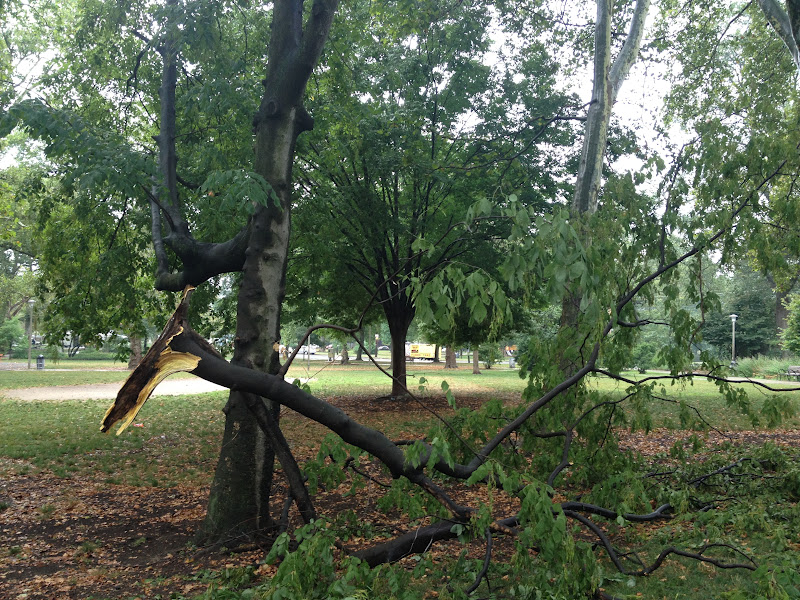
Just the other evening, I was out tree-hunting in West Philly.  It was blazing hot, steamy and sticky, so I headed to Clark Park.  I wanted to catch some shade.  I wanted to cool off and I wanted to spend the last few hours of the day watching one of my favorite oaks in the entire city.

On my way through the park, I noticed that one of the recent thunderstorms had split a branch off a yellowwood tree.


Ever wonder why it’s called a yellowwood?  Well, here’s your answer:


The oak tree that I was hunting was on the other side of the park.  It’s really one of my favorite oaks in the city.  I love the way it leans over the grassy bowl.  On this particular night, the leaning oak was the setting for a Shakespeare in the Park rendition of The Merry Wives of Windsor.


William Shakespeare was, like many artists, a romantic fan of trees and flowers, plants and herbs, nature and the wilds.  Who can forget the bloody climax of Macbeth…when Thane Macduff disguises his army as trees so they can secretly advance upon the murderous Macbeth’s castle, inspiring my favorite Shakespeare quote of all time:


I, too, have seen the woods move.

So, there I was, enjoying the oak, enjoying the shade, enjoying the Shakespeare…finally cooling off, just getting used to the Old English…when my cellphone started blowing up with voicemails and text messages, all saying the same thing: Jon Spruce, turn on the local news.  There’s a tree attacking a house in the Northeast.

I need a vacation.

Tuesday, June 19, 2012

CITY PICKINGS


Ah, summer.


Long days of blue skies, big clouds, green trees, colorful flowers, warm rain, tall grass, iced coffee in the morning and Corona beers at night.  You got your flies, mosquitos and bees, sure, but you also have the hummingbirds and woodpeckers -- the season of the bear, the bat and the beaver, the ant and the squirrel. 

It’s also the season of sweating on the couch.

According to the Farmer’s Almanac, the northern summer solstice begins this week, a stretch of long, long days clocking in at 14 hours and 47 minutes, gray moons in the blue evening skies.  If we were cabin-bound in northern Inuit country, then we might be able to see old Sol, for a brief moment, standing still in the sunny midnight hour.  The origin of the word solstice is a combination of sol for “sun” and sistere which means “stands still.”

According to the Medicine Wheel, Wabun the Golden Eagle is flying away from his nest-throne and Shawnodese the Coyote Trickster begins the next three-moon reign, beginning with the paradoxical Strong Sun Moon.  Although considering that the sun and the moon share the sky during this season, maybe the Wheelmakers were on to something there.

If I had any of the spirit of Wabun in me, then I wouldn’t be here right now, in an air-conditioned urban cabin on some numbered street in just another grid in just another city somewhere along this great sprawling megalopolis. 

No, I’d be high-tailing it to the Big Horn county of Wyoming, ten-thousand feet up Medicine Mountain, and I’d be watching the sun rise along its solstice while sitting Indian-style at the southern cairn of an actual medicine wheel. 


Up on Medicine Mountain, there be one of the largest surviving Medicine Wheels, seventy-five feet in diameter, over eight hundred years old, perfectly aligned with the northern summer solstice.

Now that’s the kind of entrance that the Coyote deserves.

If Wabun the Golden Eagle is all eyes and wing, then Shawnodese the Coyote Trickster is all teeth and heart and, for better or for worse, all that the teeth devour and all that the heart ignites: love, hate, fear, sympathy, envy, jealousy, delight, rage, anger, desire, regret, hunger.

And so, it is only appropriate, that the Coyote’s three moons are dominated by the family of trees called the Roses.

Wednesday, April 25, 2012

PATTERNS: A KEY TO NAMING THE TREES


People are always asking me: Jon Spruce, how would you define ‘nature’ using only one word?

One word?  That’s easy.  Patterns.  The one word is patterns.

If you said cycles, I wouldn’t kick you out of the cabin.  That’s an excellent word to describe nature but I can’t see nature's cycles in my lifetime and I certainly can’t see them tree-hunting on these city streets. 


When I stare into the shaman’s fire and think in terms of nature’s endless cycles, I see images of Pangaea dispersing into continents, India crashing into China, dinosaurs surviving as birds, ice ages melting into rainforests, magma rocks building sedimentary shelves, underwater volcanoes sprouting sandy islands, drought and rain burying fossils, a 2.5-inch cone that I can squeeze between my fingers growing into the California Bigtree we call Sequoia and, above it all, the milky cloud-cover spinning forever around our blue planet.  And moss.  Lots of moss.

I’ll stick with patterns.  When I’m out tree-hunting, I’m looking for patterns.  The patterns help me identify the tree.   

Maybe it’s the way the branches are growing – opposite or alternate?  Maybe it’s the pattern of leaf shapes and sizes.  It could be the bark or the fruit.  If I can recognize the pattern that the tree is growing into, then I got a good shot at putting that tree into a family or a group, one step closer to knowing its name.     

Patterns in trees.

I’ll show you what I mean.

Tuesday, March 20, 2012

MARCH MAGNOLIAS: BLOSSOMS BLOOMING

Tonight is the rising of the Budding Trees Moon and, with that rising, spring has begun in Philadelphia.

Sunny days, pleasant evenings and foggy mornings: that’s what it takes to make all these barren, leafless branches pop with spring.  Like most citybillies, I have an uncanny sense of weather and I predict that, by the end of next week, Philadelphia will be all leafed out.  It’s happening right now.


FIRST MOON OF WABUN 

This is the season of the Angiosperms, the tremendous clade of flowering plants that first took over the world 140-million years ago, just when the feathered dinosaurs were evolving into birds on the banks of the great super-continents.  The Gymnosperms, with their evergreen needles and their naked cones, rule the winter moons but for the rest of the year, it’s all Angiosperms and those lovely modified leaves that we call flowers.

Do I sound happy and bright?  Can’t help it.